The New Economics of Insurance Distribution
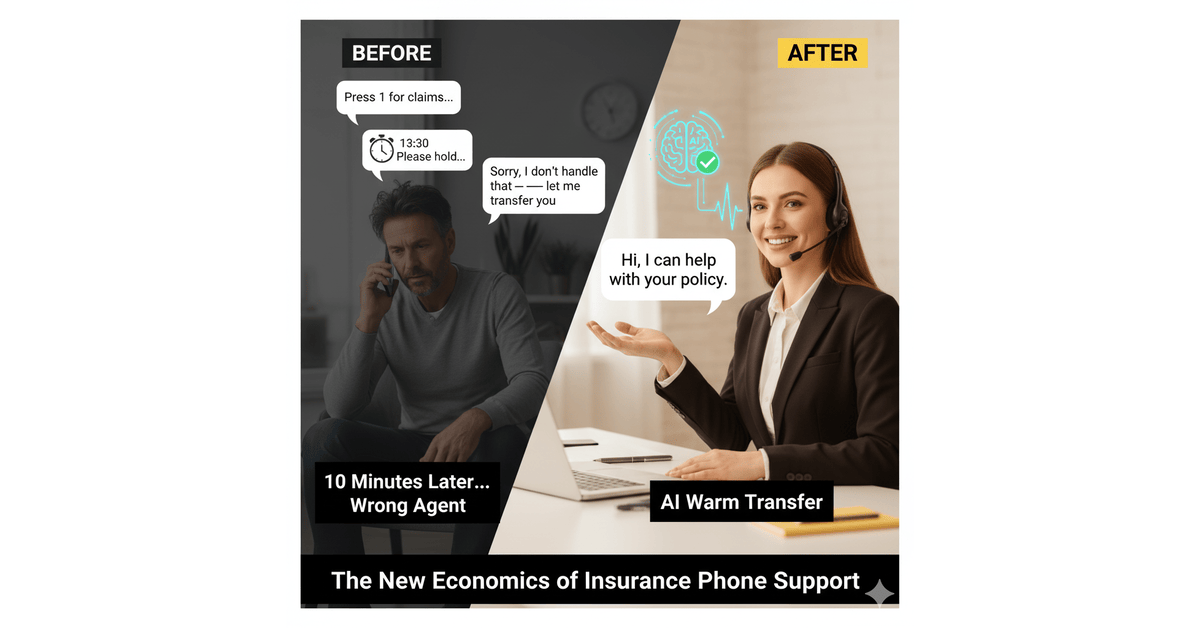
In insurance, the phone is still the heartbeat. It’s where people turn when it matters: a renewal notice, a new car, a claim. No other channel carries the same urgency or trust.
But the experience has a reputation, and it’s not a good one. It’s seen as slow, costly, hard to staff, and even harder to modernize. For years, agencies and carriers have been told to deflect: push people to portals, apps, or chat.
The reality is simpler: phone isn’t the problem. Outdated systems and workflows are.
The Economics of Insurance Phones
The costs behind phone support are real, and they add up fast:
- High per-call expense. A single inbound call can cost $8–$15 once you factor in licensed labor, intake, and compliance (industry averages across contact centers run $2.70–$5.60). Thousands of calls per week magnify the spend.
- Staffing limits. Producer pipelines have stagnated. Every new hire spends 30–40% of their day on callbacks, intake, and re-entry: instead of binding policies, working renewals, or servicing existing customers.
- Legacy automation drag. IVRs and call-center platforms weren’t designed for insurance complexity. They shuffle people through menus but can’t capture nuance, urgency,or licensing context. That's why modernization has stalled: not because leaders won’t invest, but because the tools they’re offered don’t solve the core problems.
The result: premium dollars wasted on intake and failed transfers, while the revenue moments: quoting, advising, binding- get squeezed.
Why Phone Trees Fail in Insurance
Traditional IVRs were built to handle call volume, not resolve customer needs. That creates predictable issues:
- Menus that don’t map to what the customer actually needs.
- Transfers to agents who aren’t licensed in the right state or product line.
- Long holds and repeated questions that chip away at trust.
That doesn’t mean automation itself is obsolete. At their best, automated systems should reduce friction. The problem is that most setups are rigid, key-press driven, and blind to context.
Modern voice AI is the evolution of IVR. It listens in natural language, interprets urgency, and checks licensing and availability in parallel before handing off. The outcome: the efficiency IVR promised, without the frustration.
Quote Intake: Where Shopping Breaks Down
Here’s what it looks like today:
I go online to shop for a policy. The first thing I hit is a clunky web form where I need to add my name, phone, email, vehicle details, prior carrier. Ten minutes later, I’m told someone will call me back.
When the callback finally comes, the producer asks me to repeat most of the same details just to confirm them. Only then can I book an appointment or start the actual quoting process.
That’s two steps too many. It wastes my time, it wastes the producer’s time, and it kills momentum when I’m actively shopping.
This is where voice AI changes the experience. A voice agent can capture and qualify details in natural conversation state, product, exposure, timeline- and immediately route to the right licensed producer or book a slot automatically. No forms. No callbacks. No repeats.
If shopping is the moment of highest intent, intake shouldn’t be the barrier. It should be the gateway.
Resolution-First: Changing the Model
With Infer’s Voice AI:
- Every call is answered, even after hours. No blackout zones.
- Intake happens in natural language. “I need coverage for a new truck in Texas” becomes structured data in AMS/CRM.
- Routing is qualification-aware. License, product expertise, and availability are checked in parallel before a transfer.
- Context flows forward. Producers see everything already captured - no repeats, no wasted time.
The result: producers focus where they create value coverage trade-offs, pricing, binding not callbacks and re-entry.
The New Math of Insurance Phones
When calls resolve instead of route, the economics change:
- Handle time drops. AI-enabled call centers report cuts of 15–40% in average handle time (AHT).
- Containment rises. Self-service completion improves 5–20%, reducing assisted volume without hurting CX.
- First-call resolution climbs. Insurers integrating AI into call centers see 25–30% higher FCR (Boston Consulting Group).
- Conversion lifts. Forrester research shows callers convert 28% faster and spend more than digital-only leads but only if they’re kept engaged on that first call.
- Cost-to-serve falls. End-to-end AI programs have delivered 20–30% reductions in service cost by cutting repeats and assisted escalations.
For a 100-agent shop handling 5,000 calls weekly, even modest improvements unlock hundreds of hours monthly- the equivalent of several new hires, without adding headcount.
Why Now
Customers aren’t abandoning the phone. McKinsey finds it remains the most trusted channel when the stakes are high - even for Gen Z, who still rank live calls as the fastest way to resolve complex issues.
What customers are abandoning is the experience. Menus, holds, and failed transfers destroy trust before a policy is even bound.
Resolution-first AI flips that equation. It turns the phone back into what it should be: fast, trusted, and profitable.
Ready to Modernize Your Phones?
Infer is purpose-built for insurance complexity - licensing, product specialization, availability, and intake from the very first interaction.
Ready to bring your insurance phone support into the modern era? Get a custom demo of Infer’s Voice AI.
Resources used
- https://www.forrester.com/blogs/consumer-expectations-for-customer-service-dont-match-what-companies-deliver/
- https://www.mckinsey.com/capabilities/operations/our-insights/the-next-frontier-of-customer-engagement-ai-enabled-customer-service?utm_source=chatgpt.com
- https://tei.forrester.com/go/Pega/CustomerDecisionHub/?lang=en-us
- https://www.mckinsey.com/capabilities/operations/our-insights/where-is-customer-care-in-2024?utm_source=chatgpt.com
- https://www.mckinsey.com/capabilities/operations/our-insights/the-contact-center-crossroads-finding-the-right-mix-of-humans-and-ai?utm_source=chatgpt.com
- https://www.bcg.com/publications/2025/insurance-leads-ai-adoption-now-time-to-scale
- https://www.bcg.com/publications/2025/how-insurers-can-supercharge-strategy-with-artificial-intelligence