Scaling Without Hiring: How to Increase New Policies Per Agent Without Adding Headcount

The Insurance Productivity Crisis
For decades, insurance growth followed a simple formula: hire more producers, write more premium.
That formula no longer works. Demand has never been stronger:
- Commercial P&C has grown 7–9% annually in recent years (AM Best, 2023).
- Personal auto shopping spiked 13% in 2023 due to rate increases (J.D. Power, 2023).
But supply hasn’t kept pace. Licensed producer pipelines have stagnated since 2019 (BLS), and turnover remains high. The math that fueled growth for thirty years breaks down when agencies can’t staff fast enough to match rising demand.
The Productivity Gap Agencies Can’t Ignore
Activity is not the same as output. The measures that matter are:
- Policies bound per producer. The insurance equivalent of revenue per employee.
- Cycle time to bind. The speed at which a lead becomes a policy before they drift away.
- Licensed-time ratio. The share of producer hours spent advising, quoting, and binding rather than intake and admin.
Across the industry, these metrics have stalled. Demand is flowing in, but the hours that should convert it into premium are leaking away.
Why the Usual Fixes Don’t Work
Agencies have tried to plug this gap. Outsourced bookers capture leads but can’t handle licensed conversations, leaving producers to redo work. IVRs promise efficiency but push customers to abandon calls. Legacy systems collect intake but don’t sync, forcing re-entry.
Each patch trims some cost but leaves producer capacity diluted.
Misrouting: The Real Reason Calls Are Lost
A premium hike, a new car, a life change - these are customers ready to buy today. Yet too often, they never connect with an agent who can actually help.
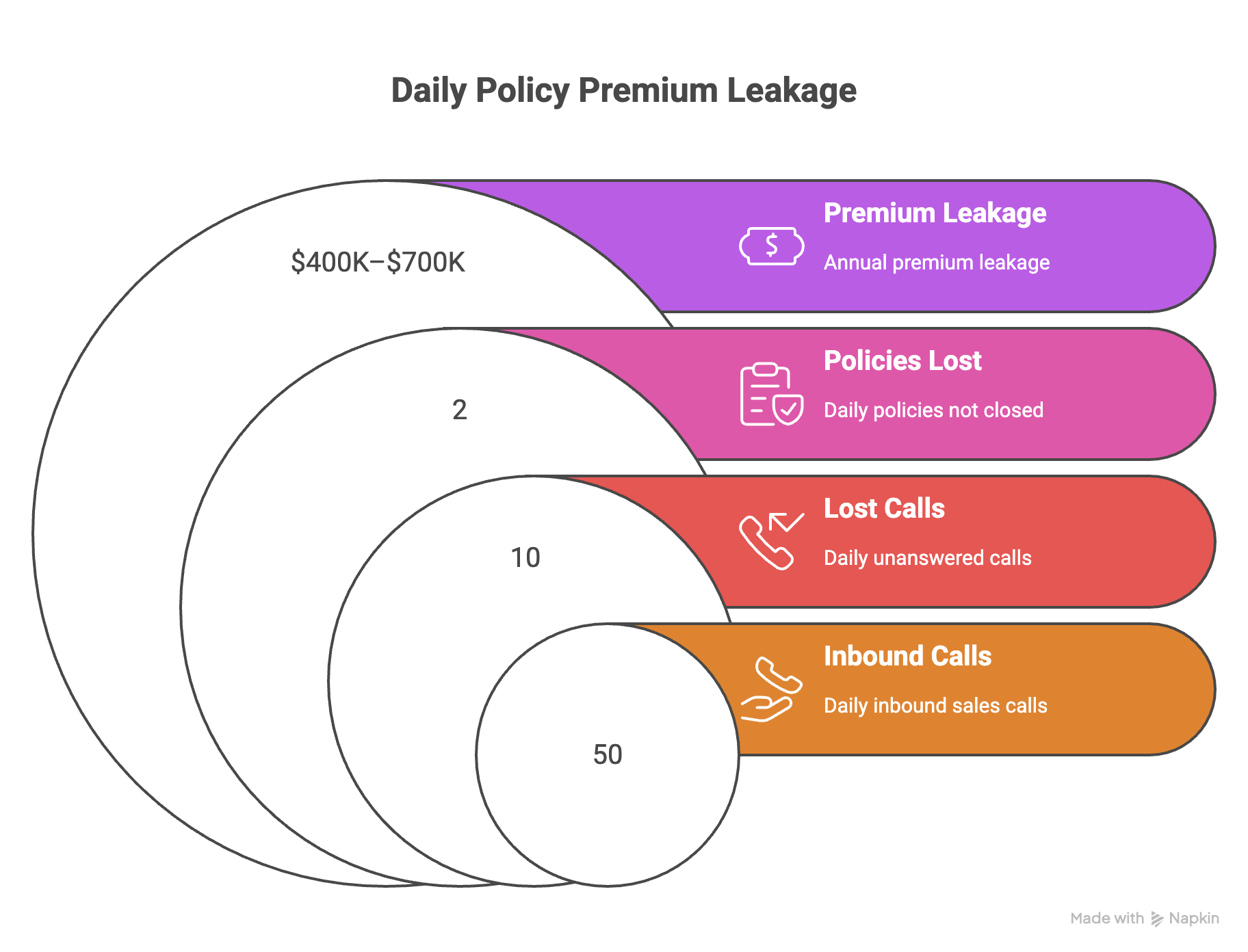
Abandonment averages 6–8% in financial services, and in some agencies creeps over 20% when routing falters (Voiso, 2023. For a mid-sized agency handling 50 inbound opportunities per day, that's 10 lost conversations daily translating to $400K–$700K in annual premium leakage.
And even when the customer gets through, they frequently land with the wrong agent. A California-licensed agent can’t bind a Florida auto policy. A commercial specialist can’t handle personal lines. Or the right agent exists but is already tied up.
Traditional routing doesn’t catch these mismatches early. “Press 1 for auto insurance” might get the customer into the system, but it doesn’t check license, product expertise, or availability until after the transfer. By then, the customer’s patience is gone and the opportunity slips away.
This customer–agent matching problem is one of the biggest drains on productivity. Every misrouted interaction wastes time, tests patience, and too often kills the sale.
The Shift: Protecting Licensed Time
Misrouting and failed handoffs are only part of the drain. Even when a customer reaches the right person, producers still lose hours to tasks that don’t require their expertise:
- Re-entering intake details across systems.
- Explaining deductibles, exclusions, and limits again and again.
- Calling back to finish incomplete applications.
- Taking calls that should never have reached them in the first place.
Voice AI changes that by redesigning intake at the front door:
- Always on. Every call is answered, even after hours. Leads are captured before they go cold, instead of disappearing into voicemail. Modernize your voicemail system to handle intake automatically.
- Natural intake. Customers explain their needs in plain language; the system understands intent, and extracts & structures the required data.
- Complete capture. No partial forms or missed details. Information flows directly into AMS/CRM, ready for quoting.
- Smart routing. Only once the case is qualified does it reach a producer, matched to licensing, state, and product expertise.
The effect is simple: producers join the conversation at the point where their expertise matters - coverage trade-offs, pricing, binding, not intake chores. That’s how you protect licensed time, and why efficiency and growth compound.
Why Adopting Voice AI Is Not Easy
As Frank Volckmar of TCG Process has noted (Insurance Business Mag), many insurers underestimate what it takes to make automation work. The common gaps are operational:
- Standardization. Consistency of processes (repetitive, and high volume that are tested over time) are the best signal of selecting ones to automate.
- Trust. One wrong coverage limit or misclassified state license creates compliance risk. Unless outputs are consistently accurate and explainable, you won’t let the system run end-to-end.
- Evaluation. Too often, privacy, security, and performance aren’t built in from the start. When they’re tested late, fixes are expensive and momentum is lost.
Voice AI runs into similar hurdles:
- Early tech. Speech recognition struggled with accents, noise, and insurance jargon. IVRs forced customers through menus without capturing intent. Modern speech recognition, natural voices, and insurance-tuned models now perform at a level where these basics aren’t the blocker.
- Legacy systems. Even when intake is accurate, pushing that data into AMS or CRM takes months. Integration delays are one of the biggest reasons pilots never scale.
- Sequential design. Most implementations still process one step at a time: intake, then routing, then license checks, then availability. If any step fails, the call fails. Parallel orchestration allows these to run together, so by the time the customer finishes speaking, the right licensed agent is already on the line.
Overcoming these hurdles isn’t simple, but where they’ve been addressed, the impact is clear. McKinsey documented a European AI-first MGA that sold 100,000 policies with only six employees. In the U.S., an MGA we worked with replaced its IVR with parallel AI booked 86% of inbound calls directly into appointments.
Implementation like these have revolved around solving structural problems like:
- Routing customers to the right agent the first time.
- Keeping producers focused on coverage and pricing, not intake and re-entry.
- Building systems that move data seamlessly instead of stalling it.
This is the layer we’re working on with agencies and carriers: making sure producer time is spent where it creates value, and every inbound opportunity has a straight path to binding
From Pilots to Productivity
The examples that work all point in the same direction: real gains come from solving structural problems. Customers must reach the right agent on the first try. Producers need to spend their time on coverage and pricing, not intake and re-entry. Systems have to pass data cleanly instead of stalling it.
Infer works with agencies and carriers to raise productivity per producer by fixing misrouting, automating clean intake, and shortening the path from intent to bound policy. Talk to us about where your workflows stall today, and we can help turn those gaps into measurable growth.
See how you can write more policies per agent. Get a custom demo of Infer’s Voice AI.
References
- https://www.mckinsey.com/industries/financial-services/our-insights/insurance-blog/direct-insurance-in-europe-a-growth-trajectory-for-the-future
- https://www.mckinsey.com/industries/financial-services/our-insights/the-future-of-ai-in-the-insurance-industry
- https://media.bain.com/Images/BB_Top_line_bottom_line_insurance.pdf
- https://www.jdpower.com/business/press-releases/2024-us-independent-agent-satisfaction-study
- https://www.insurancebusinessmag.com/ca/best-insurance/top-insurtech-companies--global-5star-technology-and-software-providers-543650.aspx
- https://www.insurancebusinessmag.com/us/news/technology/insurance-agents-warm-to-ai-but-uptake-remains-uneven-liberty-mutual-547648.aspx
- https://voiso.com/articles/call-abandonment-rate/
- https://www.contactbabel.com/the-us-contact-center-decision-makers-guide/
- https://assets.ringcentral.com/us/report/us-dmg-2024.pdf