What 40% of Insurance Customers Don’t Understand What They Bought
Fixing the Drop in Confidence Between Quote and Renewal - Building an Experience-centric-journey with Voice AI
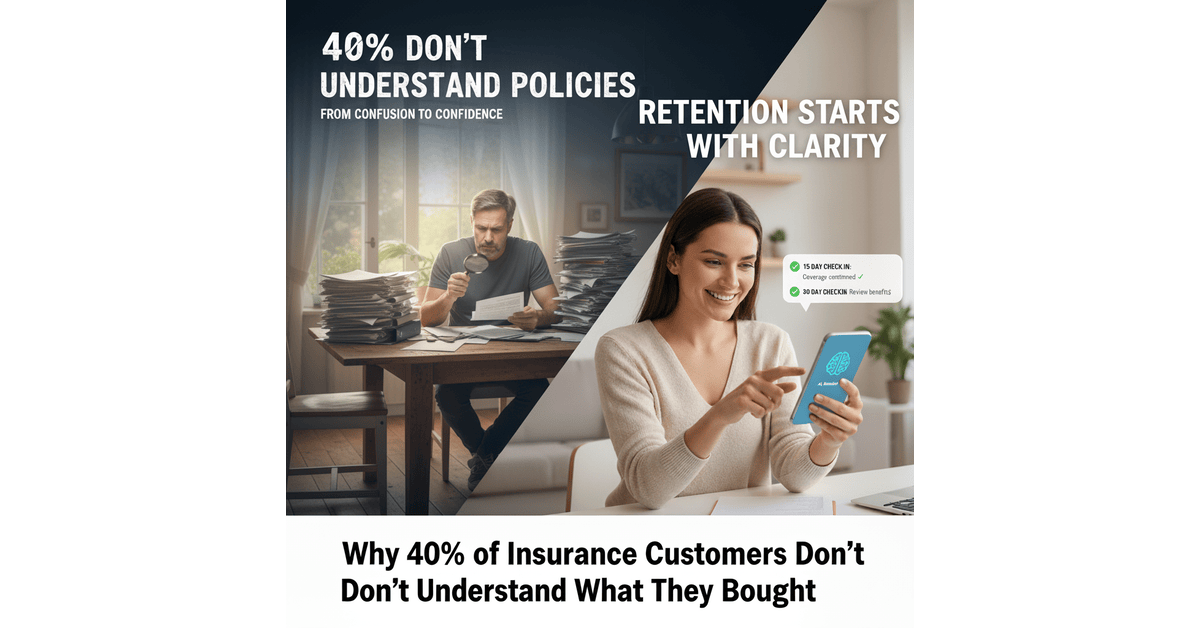
McKinsey uncovered a truth the industry doesn’t like to admit: 40% of customers who considered canceling their policy did so because they didn’t think it was necessary or valuable. (Mckinsey Insights Report)
Not because of price. Because they didn’t understand what they had purchased.
That’s four in ten customers. Imagine nearly half your book of business doubting the value of what they’re paying for.
The Cognitive Load Crisis
Insurance isn’t just another financial product it carries the heaviest mental burden of them all.
- A mortgage is one decision with fixed terms.
- A bank account has predictable fees.
- Insurance? Dozens of variables, unfamiliar language, and risks people hope they’ll never face.
A research study quantified: buying insurance requires, on average, 47 separate decision points. Compare that to opening a bank account (12 decisions) or taking a loan (16). (ResearchGate)
McKinsey found that customers reach out to insurers an average of four times just to try to understand and compare products. By the fourth attempt, they aren’t learning anymore, they’re exhausted. They buy just to stop thinking about it.
And the problem isn’t only complexity of the product. The distribution system itself compounds confusion- agents, brokers, aggregators, even group channels- all presenting information slightly differently and providing fragmented service and experiences.
The result: renewal sends customers back to shopping their policies- when it should have been a default continuation, earned by service and trust.
Where the Journey Actually Breaks
- Customers don’t really understand their coverage. Only 56% of auto and 55% of home customers say they completely understand what their policy covers (JD Power - Insurance shopping report 2024)
- Renewal decisions are fragile and fluid. In 2024, 49% of auto customers shopped and 29% switched; in 2025, shopping jumped to 57% Renewal is a live decision point- easy to lose, easy to win. (JD Power report)
- Retention hinges on experience at key moments. Bain research shows that a good experience especially at renewals and claims can retain customers even when premiums rise . (Bain report)
- This takes multiple, connected touchpoints. Consumers interact with brands across an average of nine touchpoints; each one must build on the last, not reset .
From Policy-Centric to Experience-Centric Journey’s
In Insurance 2030: From Customer Worst to Customer First, PwC highlights a fundamental shift: the future isn't about pushing products, it's about creating experience-centric journeys where engagement, understanding, and advice flow continuously in real time.
Most carriers still think in policy cycles - quote, bind, renew, repeat. But customers live in life cycles - buying a home, starting a business, getting married, having kids. Their insurance needs shift constantly, but their experience with carriers remains stuck in annual touchpoints.
How Infer Bridges This Gap and enables experience-centric journeys
Instead of fragmented interactions that start from zero each time, Infer creates a continuous conversation that builds context and confidence over time:
- From evaluation to quote intake → context captured once Customers shouldn’t have to re-explain their situation every time they engage. Infer makes the first conversation the foundation capturing the details, needs, and concerns once, and carrying them forward across every interaction.
- From quote to decision → clarity built step by step Nobody digests insurance in a single call. Instead of forcing an overload, Infer spaces out explanations coverage limits, deductibles, benefits so customers gradually build confidence in their understanding. Each interaction adds one more piece to the puzzle.
- Throughout the year → proactive updates Policies aren’t static. Endorsements, new benefits, and life changes shift the value customers get. Infer keeps them informed in real time, surfacing relevant changes before they become surprises.
- Outside office hours → always-on access Most insurance questions come up when people are actually reviewing bills or talking to family often after hours. Infer is there in the moment, capturing questions and providing immediate clarity, so the next human follow-up starts with full context.
- At renewal → relationship-driven confidence Renewal is the most fragile moment, with over half of customers shopping around. Infer reduces that churn risk by reinforcing coverage and benefits throughout the year, so renewal isn’t a re-evaluation it’s a continuation. Customers enter renewal already confident in what they own.
- Personalized guidance → tuned to segments Not every customer learns the same way. Using experimentation, Infer adapts tone, sequence, and messaging across segments whether it’s a first-time auto buyer or a commercial policyholder so guidance feels relevant and sticks.
Fix the Problem at Its Source
Every interaction is either deepening clarity or adding to the fog. Either reinforcing the value of coverage or letting doubt creep in. Either setting up a confident renewal or pushing a customer back into shopping mode.
McKinsey quantified the cost: 40% of customers don’t understand what they bought. PwC outlined the opportunity: real-time engagement and advice that strengthen confidence over time.
The tools to deliver that already exist. Infer provides the infrastructure to keep context alive across calls, updates, and renewals so customers feel informed instead of overwhelmed, and producers spend time advising instead of re-explaining.
If you’re exploring how to move from fragmented touchpoints to continuous engagement, let’s talk. We’d be glad to share what we’ve learned building with agencies like yours.
Start building customer journeys that retain. Get a custom demo of Infer’s Voice AI.
References
- https://www.mckinsey.com/industries/financial-services/our-insights/insurance/elevating-customer-experience-a-win-win-for-insurers-and-customers
- https://www.researchgate.net/publication/324246281_Decision-Making_Biases_in_Insurance_Purchasing
- https://hub.jdpower.com/insurance-shopping-confused-customers
- https://www.jdpower.com/sites/default/files/file/2024-04/2024033%20U.S.%20Insurance%20Shopping.pdf?utm_source=chatgpt.com
- https://www.bain.com/insights/how-to-improve-customer-retention-in-property-and-casualty-insurance-snap-chart/?utm_source=chatgpt.com
- https://www.pwc.com/us/en/industries/financial-services/library/insurance-customer-experience.html